A Proof of the Extended Descartes' Circle Theorem
Given three circles, mutually tangent, with radii a b and c, the problem of drawing a fourth circle, nestling in the region enclosed by the three circles, and touching each of them, is essentially solved by Descartes' equation. For this determines the radius d of the fourth circle -- and its centre can be found by drawing arcs of radius a+d and b+d, respectively, from the centres P and Q of the first two circles.
Surprisingly, the centre of the fourth circle can be found directly by solving a rather simple equation. This is the import of the remarkable 'extended' circle theorem discovered by Lagarias, Mallows and Wilks in 2001[1]. For this we need to introduce coordinates in the plane of the circles; which means choosing an origin of coordinates, and a fixed 'unit' vector which will determine the scale and direction of the x-axis. The y-axis will be at right angles to the x-axis, and scaled the same. Then each point of the plane will have an x-coordinate and a y-coordinate; and these may be combined into a complex coordinate
\[ z = x+iy. \]
Let p, q, r, s be the complex coordinates of the centres P, Q, R and S. Then the extended theorem says
\[ \left\{\frac{p}{a} + \frac{q}{b} + \frac{r}{c} + \frac{s}{d} \right\}^{2} = 2 \left\{ \frac{p^{2}}{a^{2}} + \frac{q^{2}}{b^{2}} + \frac{r^{2}}{c^{2}} + \frac{s^{2}}{{d}^{2}} \right\} . \]
Note that nothing has been said concerning the actual choice of coordinate system: the equation is claimed to hold for all such choices. A different choice of 'unit vector' is a relatively minor matter; for the equation will still hold if p, q, r and s are all multiplied by some complex number number λ: each side of the equation is just multiplied by λ². But a change of origin is another matter. Suppose the origin is moved from zero to w; in the new system, the coordinates of the centres will be p-w, q-w, r-w, s-w, and the left-hand side of the equation will become
\[ \left\{\frac{p-w}{a} + \frac{q-w}{b} + \frac{r-w}{c} + \frac{s-w}{d} \right\}^{2} \] \[ = \left\{\frac{p}{a} + \frac{q}{b} + \frac{r}{c} + \frac{s}{d} \right\}^{2} -2w\left\{\frac{1}{a} + \frac{1}{b} + \frac{1}{c} + \frac{1}{d}\right\} \left\{\frac{p}{a} + \frac{q}{b} + \frac{r}{c} + \frac{s}{d} \right\} \;+\; w^{2}\left\{\frac{1}{a} + \frac{1}{b} + \frac{1}{c} + \frac{1}{d} \right\}^{2} ,\]
and the right-hand side:
\[ 2 \left\{ \frac{p^{2}}{a^{2}} + \frac{q^{2}}{b^{2}} + \frac{r^{2}}{c^{2}} + \frac{s^{2}}{{d}^{2}} \right\} - 4w\left\{ \frac{p}{a^{2}} + \frac{q}{b^{2}} + \frac{r}{c^{2}} + \frac{s}{{d}^{2}}\right\} + 2w^{2} \left\{ \frac{1}{a^{2}} + \frac{1}{b^{2}} + \frac{1}{c^{2}} + \frac{1}{{d}^{2}} \right\} . \]
If these are to be equal for all values of w, the terms linear in w, and those involving w² must be equal separately. Equating the terms involving w² just gives us the Descartes equation again; but those linear in w give us a new equation:
\[ \left\{\frac{1}{a} + \frac{1}{b} + \frac{1}{c} + \frac{1}{d}\right\} \left\{ \frac{p}{a} + \frac{q}{b} + \frac{r}{c} + \frac{s}{d} \right\} = 2\left\{ \frac{p}{a^{2}} + \frac{q}{b^{2}} + \frac{r}{c^{2}} + \frac{s}{{d}^{2}}\right\} . \]
(Note that if this new equation is valid in one coordinate system, then it is valid in all, provided the Descartes equation is satisfied.) What all this tells us is that if we can prove that the extended equation, and the new equation, are valid in one coordinate system (chosen, perhaps, to suit ourselves) then they will remain valid in all other coordinate systems.
There is in fact a choice of origin which will suit us very well: namely, such that the origin coincides with S, the centre of the fourth circle. As for the unit vector, it may as well point in the direction SP. With this choice, and making use of the quantities A, B, C, θ, φ, ψ introduced in part one, we have:
\[ p = a+d = A \] \[ q = (b+d)e^{i\theta} = Be^{i\theta} \] \[ r = (c+d)e^{-i\psi} = Ce^{-i\psi} \] \[ s = 0 . \]
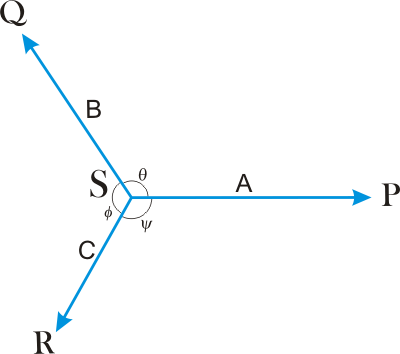
Figure3
Proof of the 'new equation'
Now let's see if we can prove the 'new equation', which says that
\[ V \equiv \lambda p + \mu q + \nu r = 0 \]
where
\[ \lambda = \frac{2}{a^{2}} - \frac{1}{a}(\frac{1}{a} + \frac{1}{b} + \frac{1}{c} + \frac{1}{d} ) \] \[ \mu = \frac{2}{b^{2}} - \frac{1}{b}(\frac{1}{a} + \frac{1}{b} + \frac{1}{c} + \frac{1}{d} ) \] \[ \nu = \frac{2}{c^{2}} - \frac{1}{c}(\frac{1}{a} + \frac{1}{b} + \frac{1}{c} + \frac{1}{d} ) . \]
We note that λ may be re-expressed as follows:
\[ \lambda = \frac{1}{a}(\frac{1}{a} - \frac{1}{b} - \frac{1}{c} - \frac{1}{d} ) \] \[ = \frac{1}{a}(\frac{1}{a} + \frac{1}{d}- \frac{1}{b} - \frac{1}{d} - \frac{1}{c} - \frac{1}{d} ) \] \[ = \frac{1}{ad}(\frac{A}{a} - \frac{B}{b} - \frac{C}{c} ) = \frac{1}{ad}(\frac{1}{\alpha} - \frac{1}{\beta} - \frac{1}{\gamma} ) \]
(where we have made use of the quantities α, β, γ introduced in part one). Similarly,
\[ \mu = \frac{1}{bd}(\frac{1}{\beta} - \frac{1}{\alpha} - \frac{1}{\gamma} ) \] \[ \nu = \frac{1}{cd}(\frac{1}{\gamma} - \frac{1}{\alpha} - \frac{1}{\beta} ) . \]
Now, consider the real part of V, and use the expressions for cos(θ), cos(ψ) derived in part one:
\[ Re[V] = A \lambda + B cos(\theta) \mu + C cos(\psi) \nu \] \[ = \frac{1}{d} \left\{ \frac{1}{\alpha} (\frac{1}{\alpha} - \frac{1}{\beta} - \frac{1}{\gamma} ) + \frac{1}{\beta} (\frac{1}{\beta} - \frac{1}{\alpha} - \frac{1}{\gamma} )(1-2\alpha\beta) + \frac{1}{\gamma} (\frac{1}{\gamma} - \frac{1}{\alpha} - \frac{1}{\beta} )(1-\alpha\gamma) \right\} \] \[ = \frac{1}{d} \left\{ \frac{1}{\alpha^{2}} + \frac{1}{\beta^{2}} + \frac{1}{\gamma^{2}} -2(\frac{1}{\alpha\beta} + \frac{1}{\beta\gamma} + \frac{1}{\gamma\alpha}) + 4 \right\} = \frac{F(\alpha,\beta,\gamma)}{d} = 0.\]
Again, the equation
\[ F(\alpha,\beta,\gamma) = 2( \frac{1}{\alpha^{2}} + \frac{1}{\beta^{2}} + \frac{1}{\gamma^{2}} )- (\frac{1}{\alpha} + \frac{1}{\beta} + \frac{1}{\gamma})^{2} + 4 = 0 \]
was derived in part one. We could now consider the imaginary part of V, but this is not such a good idea, because the expressions for sin(θ) and sin(ψ) involve square roots. Instead we consider the component of V in the direction SQ, or, what comes to the same thing
\[ Re[Ve^{-i\theta}] = Re [ Ae^{-i\theta} + B + C e^{i\phi} ] .\]
However, it is hardly necessary to calculate this, as the expression will be the same as before but with β substituted for α, γ for β and α for γ. This will make no difference to the function F, which will be zero as before.
Therefore all components of V are zero, and the 'new equation' is proved.
Proof of the Extended Theorem
Our concern now is with the complex number W defined as
\[ W \equiv (\frac{A}{a} + \frac{Be^{i\theta}}{b} + \frac{Ce^{-i\psi}}{c})^{2} - ( \frac{A^{2}}{a^{2}} + \frac{B^{2}e^{2i\theta}}{b^{2}} + \frac{C^{2}e^{-2i\psi}}{c^{2}} ) \] \[ = ( \frac{A^{2}}{a^{2}} + \frac{B^{2}e^{2i\theta}}{b^{2}} + \frac{C^{2}e^{-2i\psi}}{c^{2}} ) - 2 (\frac{ABe^{i\theta}}{ab} + \frac{ACe^{i\theta}}{ac} + \frac{BCe^{i(\theta - \psi)}}{bc}) \] \[ = ( \frac{1}{\alpha^{2}} + \frac{e^{2i\theta}}{\beta^{2}} + \frac{e^{-2i\psi}}{\gamma^{2}} ) - 2 (\frac{e^{i\theta}}{\alpha\beta} + \frac{e^{-i\psi}}{\alpha\gamma} + \frac{e^{i(\theta - \psi)}}{\beta\gamma}) \]
We seek to prove that W is equal to zero. To this end we begin by considering the real part of W:
\[ Re[W] = \frac{1}{\alpha^{2}} + \frac{cos(2\theta)}{\beta^{2}} + \frac{cos(2\psi)}{\gamma^{2}} - 2 \frac{cos(\theta)}{\alpha\beta} -2 \frac{cos(\psi)}{\alpha\gamma} -2 \frac{cos(\theta - \psi)}{\beta\gamma} \]
Now, we may substitute our usual expressions for cos(θ) and cos(ψ); cos(2θ) and cos(2ψ) can be expressed in terms of the same quantities; cos(θ-ψ) appears at first sight to pose a problem as its expansion involves the sines of θ and ψ as well as their cosines. However, we can get around this problem as follows:
\[ cos\left(\theta -\psi \right)= cos\left(\theta \right)cos\left(\psi\right) + sin\left(\theta \right) sin\left(\psi\right) \] \[ cos(\phi) = cos\left(\theta +\psi \right)= cos\left(\theta \right)cos\left(\psi\right) - sin\left(\theta \right) sin\left(\psi\right) \] \[ \therefore cos\left(\theta -\psi \right)= 2cos\left(\theta \right)cos\left(\psi\right) - cos(\phi) = 2 (1 - 2\alpha\beta)(1 - 2 \alpha\gamma) - (1 - 2 \beta\gamma) . \]
Putting all this into the expression for Re[W] we obtain
\[ Re[W] = \frac{1}{\alpha^{2}} + \frac{1}{\beta^{2}}(2(1-2\alpha\beta)^{2}-1) + \frac{1}{\gamma^{2}}(2(1-2\alpha\gamma)^{2}-1) \] \[ - \frac{2}{\alpha\beta}(1-2\alpha\beta) - \frac{2}{\alpha\gamma}(1-2\alpha\gamma) - \frac{2}{\beta\gamma} (2 (1-2\alpha\beta)(1-2\alpha\gamma) - (1-2\beta\gamma) ) ,\]
which, when shaken down, comes to
\[ \frac{1}{\alpha^{2}} + \frac{1}{\beta^{2}} + \frac{1}{\gamma^{2}} -\frac{2}{\alpha\beta} - \frac{2}{\beta\gamma} - \frac{2}{\gamma\alpha} + 4 = {F(\alpha,\beta,\gamma)} = 0. \]
In exactly the same way, we can calculate the components of W in the directions SQ and SR: the same quantity will arise, with cyclic permutation of α, β, γ and θ, φ, ψ. Thus all components of W are zero, as must be W itself. The extended theorem is proved◊
References
[1] J. C. Lagarias, C. L. Mallows and A. Wilks, Beyond the Descartes circle theorem, Amer. Math. Monthly 109 (2002), 338–361. [eprint: arXiv:math/0101066]